
Christian leadership isn’t a management technique borrowed from the business world and sprinkled with Bible verses. It’s rooted in a completely different understanding of what a leader is, what they’re called to do, and who they answer to. The distinction matters. A secular leader optimizes for outcomes, market share, and performance metrics. A Christian leader is shaped by Scripture, accountable to God, and called to shepherd people toward spiritual maturity and eternal purpose.
That’s why understanding biblical foundations isn’t optional. It’s the bedrock. When you see how Moses led, how David navigated failure and repentance, how Jesus redefined power through servanthood, you stop trying to fit Christianity into borrowed frameworks. Instead, you build from Scripture outward.
Biblical Foundations of Christian Leadership

Jesus as the Model
Jesus never wrote a strategic plan or called a board meeting. He led by example, washed disciples’ feet, rebuked the self-righteous, and spent time with the overlooked. In Matthew 20:26-28, He’s explicit: whoever wants to be great must be a servant. That’s not inspirational language. That’s a fundamental inversion of how power works.
His leadership was marked by authority that came from truth, not position. People followed because His words aligned with reality and His actions matched His words. That consistency is rare.
Moses: Humility and God’s Calling
Moses didn’t want the job. When God called him to lead Israel out of Egypt, Moses argued. He was inadequate, he said. His speech was poor. He was afraid. God didn’t fix those things first. He called Moses anyway, then equipped him as he went.
What made Moses effective wasn’t charisma or natural talent. It was his willingness to surrender to God’s authority over his own comfort. Numbers 12:3 describes him as “very humble, more than anyone else on the face of the earth.” That humility made him open to correction, teachable, and willing to intercede for people who frustrated him.
David: Repentance and Accountability
David wasn’t perfect. He committed adultery, orchestrated murder, and made terrible military decisions. But when confronted by the prophet Nathan, he didn’t defend himself or minimize his failure. He repented completely (Psalm 51). He was accountable to God first, not to his position or reputation.
That’s the biblical pattern. Leaders sin. They fail. But they confess, make restitution where possible, and change course. That willingness to be corrected, to admit wrong, to submit to God’s authority even when it costs them, that’s what separates Christian leadership from the kind that just looks good on the surface.
Essential Character Qualities and Virtues
Character is not optional for Christian leaders. It’s the foundation that makes every other skill or strategy meaningful. John MacArthur emphasizes that a leader’s inner life determines the health of everything they oversee. The qualities listed in 1 Timothy 3 and Titus 1 aren’t aspirational, they’re the standard for anyone stepping into spiritual authority.
Integrity and Truthfulness
Integrity means your private life matches your public one. There’s no gap between what you teach and how you live. This is why Paul tells Titus that an elder must be “blameless”, not perfect, but honest about struggle and committed to the truth regardless of personal cost.
When a leader cuts corners, people notice. When they lie to protect their reputation or smooth over conflict, trust evaporates. Integrity rebuilds slowly and breaks quickly. It’s the currency of Christian leadership.
Humility and Accountability
Humility isn’t self-deprecation. It’s an accurate assessment of your own strength and limitations. It means admitting mistakes before someone else has to point them out. It means surrounding yourself with people who will tell you the truth, even when it stings.
Paul writes in Galatians 6:1 about restoring someone caught in sin “in a spirit of gentleness.” That gentleness flows from a leader who knows they’re capable of the same failures. Accountability structures, whether that’s a board, a mentor, or a trusted peer, aren’t a burden. They’re a safeguard.
Spiritual Maturity and Self-Control
Spiritual maturity isn’t measured in years. It’s measured in how you handle pressure, disappointment, and temptation. Self-control, what Paul calls “temperance” in some translations, means your emotions don’t run your decisions. Your convictions do.
This matters because leaders set the tone. If you’re reactive, your team becomes reactive. If you’re patient under pressure, they learn patience. 1 Peter 5:8 reminds us that spiritual warfare is real, and a leader without self-control becomes an easy target.
Servant Heart and Love for Others
Jesus washed his disciples’ feet. That act wasn’t ceremonial, it was a statement about what leadership means. A servant heart means your power is spent on behalf of others, not for your own advancement.
MacArthur points out that love for the flock is the prerequisite for shepherding them well. If you’re leading for status or security, people sense it. If you genuinely care about their growth and wellbeing, that shapes every decision you make.
Practical Leadership Skills and Ministry Application

Christian leadership isn’t abstract. It lives in how you spend your time, make decisions, and treat the people you lead. The qualities we’ve covered only matter if they move from intention to action.
Servant Leadership in Action
Servant leadership means you’re not leading from a position. You’re leading by example, doing the unglamorous work first. Jesus washed feet. He didn’t assign the task. He did it himself.
In practice, this looks like: knowing the names of people in your congregation or organization, remembering details about their lives, being available when someone has a real problem (not just scheduled office hours), and treating volunteers and staff the way you’d want to be treated.
It also means delegating without disappearing. Empower people to lead. Give them real responsibility, space to fail, and honest feedback when they do.
Discipleship and Multiplication
Christian leadership exists to develop other leaders. Your job isn’t to do all the work. It’s to equip others to do it.
This means investing in people intentionally. Meet one-on-one. Answer their questions. Share your struggles, not just your successes. Let them see how you make decisions. Model what you’re asking them to become.
Track who you’re investing in. If you can’t name 3-5 people you’re actively developing as leaders, you’re not reproducing leadership. You’re just working harder.
Wise Decision-Making
Christian leaders make decisions through prayer, counsel, and discernment, not reaction. When faced with a significant choice, slow down. Pray. Seek input from wise people who know your context. Don’t confuse speed with leadership.
This includes how you communicate decisions. Explain the “why” so people understand your reasoning, not just the outcome. Acknowledge trade-offs. Be honest about uncertainty where it exists.
Casting Vision Without Coercion
Vision should invite people, not demand their compliance. A Christian leader articulates what God is calling the organization toward, tells it clearly and repeatedly, and leaves room for people to choose to join.
When people understand the mission and feel their work matters, they show up differently. They lead others toward that same vision.
Key Takeaways
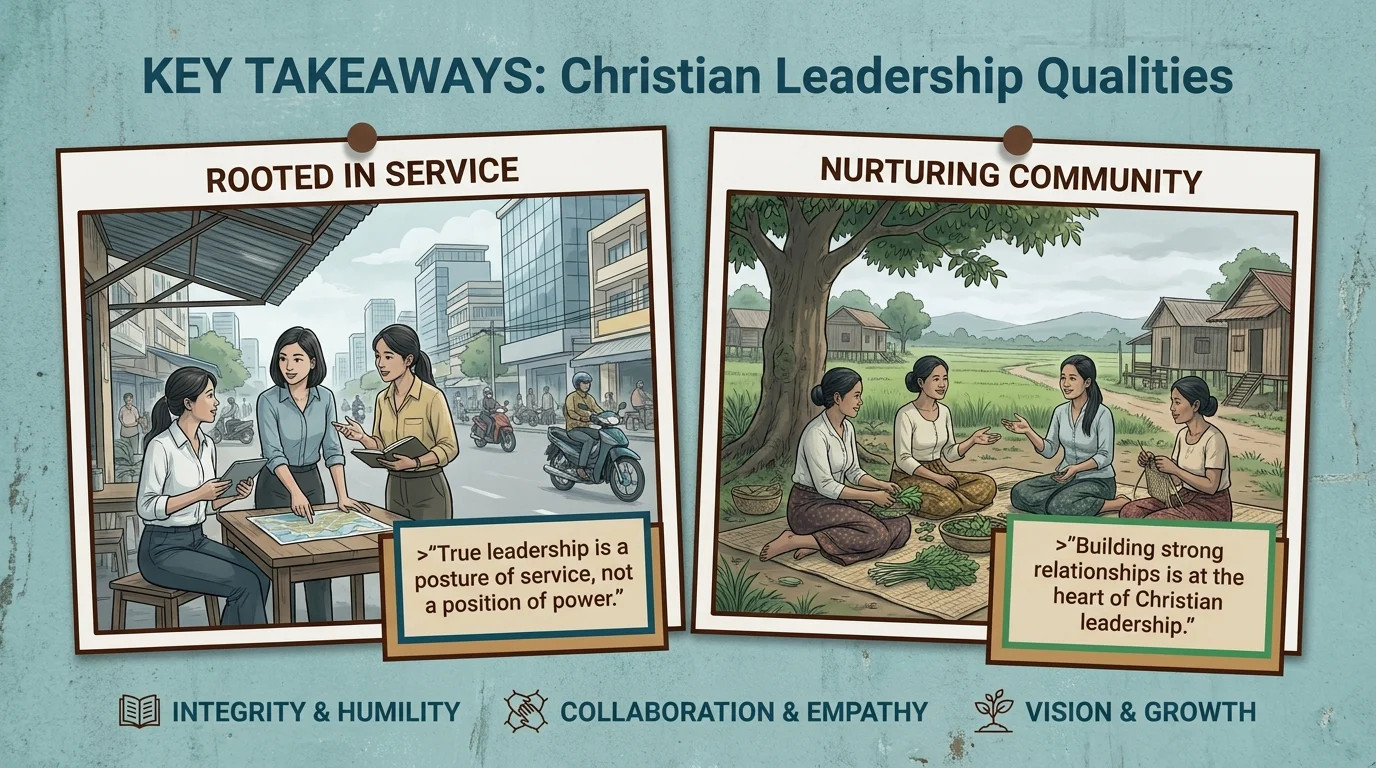
Christian leadership begins with character. It’s rooted in Scripture. And it proves itself in how you serve, develop others, make decisions, and help people move toward God’s purpose.
The qualities and practices that matter most aren’t complicated. They’re just rarely sustained. Humility. Listening. Honesty. Putting others first. These require constant choice.
That’s the work. And it’s the privilege.
Naleng Real serves in Phnom Penh, Cambodia. Orphaned at three and one of four siblings to survive the Pol Pot years, she went on to earn a Bachelor degree in English Literature at Norton University and a Master of Arts in Intercultural Studies from the East Asia School of Theology in Singapore. She has served since 1994 as a translator, interpreter, worship leader and trainer — nine years with the Assemblies of God and nine with World Vision International — and today works in church planting, Kairos facilitation and Bible translation.
All writing by Naleng →